
Five classes
165 to 250 km/h
Start in a twist-and-go Rotax, step up to the gearbox classes, and finish in a 100 hp twin. Every class races on the same full-size circuits.
- 165km/h Entry level 125 Rotax Non-Gearbox
- 175km/h Budget gearbox 125 Stock Honda
- 200km/h Open gearbox 125 National
- 215km/h Step up to 250s 250 / 450 National
- 250km/h Premier class 250 International
Entry level
125 Rotax Non-Gearbox
Light & Heavy
Twist-and-go, low running costs and close slipstream racing. The easiest way onto the grid.
The Rotax Max is superkarting’s non-gearbox class, and the cheapest way onto a full-size circuit. It suits racers on a budget and anyone without much mechanical know-how: arrive, race, and spend the day with your mates, because the karts need very little work between races.
There are two divisions: Light, at a combined kart-and-driver weight of 165 kg, and Heavy, at 185 kg. Any Rotax Max engine can be used, under rules very close to sprint karting’s. Around 30 hp gets them to about 165 km/h, and Light karts lap Sydney Motorsport Park in the 1:46s.
Running costs are very low. One $300 set of tyres can last three race meetings, and engine maintenance is minimal. The racing is about as close as it gets, with slipstreaming and tactics deciding races by the barest of margins.
Budget gearbox
125 Stock Honda
Spec gearbox
Spec engines that run a full season without a rebuild, so it comes down to the driver.
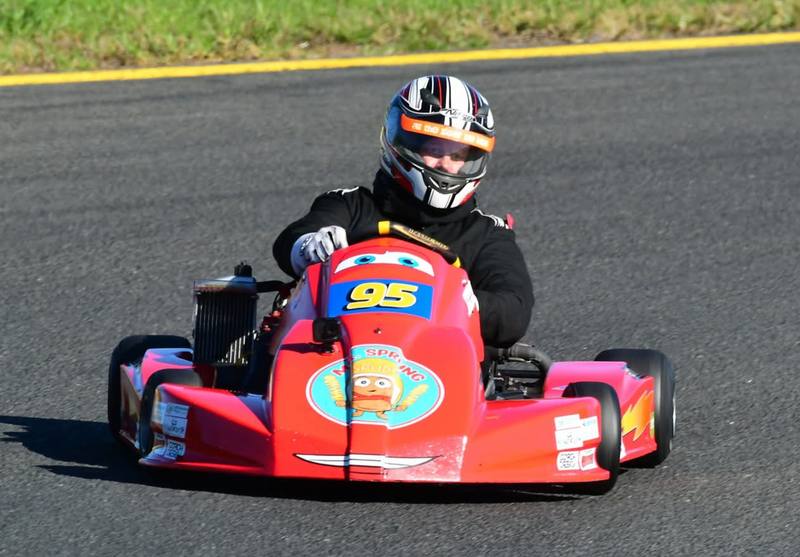
Stock Honda is a 125cc gearbox class for the budget-minded racer. It needs less maintenance and less technical skill than the other gearbox classes to run at the front, but still rewards time spent on set-up, prep and practice. The karts are so evenly matched that it comes down to the driver.
It uses CIK-approved shifter chassis with four-wheel brakes, which are easy to find in Australia. The engine is the 1999 Honda CR125 two-stroke with a six-speed gearbox, strictly regulated so every motor performs the same. They can run a full season without a rebuild, and tyres often last several meetings.
Expect around 180 km/h, with laps of 1:41 at Sydney Motorsport Park. Second-hand karts lose little to no performance, and spares are cheap at any karting or bike shop.
Open gearbox
125 National
Open 125cc gearbox
Full bodywork, wings and 200 km/h-plus. Serious speed for the money.
The open 125cc gearbox class. Most commercially available 125cc two-stroke gearbox engines are allowed, and the popular choice is the KZ125 developed for sprint shifter karts, with more freedom to modify in superkarting. Full bodywork and wings are allowed, and front and rear brakes are compulsory.
Be ready to get your hands dirty: these engines need regular maintenance and tuning to keep their 50-plus horsepower. The class weight is 195 kg (kart and driver), and lap times are impressive: 1:35.9 at Sydney Motorsport Park and 1:01.9 at One Raceway. On shorter circuits they run within two or three seconds of the 250 Internationals, topping 200 km/h at some tracks.
Got a KZ125 shifter kart? With a few additions (a rain light, for example) you can run it at any of our meetings. Get your Motorsport Australia licence, bring your mates, and you can even run as your own class.
Step up to 250s
250 / 450 National
250cc two-stroke or 450cc four-stroke
Same chassis as the Internationals, with reliable motocross engines and long service intervals.
The 250 National is the entry to 250cc racing. It mostly shares its chassis with its big brother, the 250 International, but uses 250cc two-stroke or 450cc four-stroke motocross engines.
Modified for superkart racing, they rev past 10,000 rpm and make 65-plus horsepower, at a combined minimum weight of 208 kg, reaching around 215 km/h at the faster tracks. The technical regulations leave plenty of room for savvy engine tuners.
The big benefits are low running costs and easy-to-find spares. These karts are known for reliability and long service intervals for pistons and cranks. The big single-cylinder engines do shake a bit, but that’s soon forgotten as they deliver the excitement lap after lap.
Premier class
250 International
Division 1
Division 1. Full aero, four-wheel discs, 250 km/h. The fastest karts on earth.
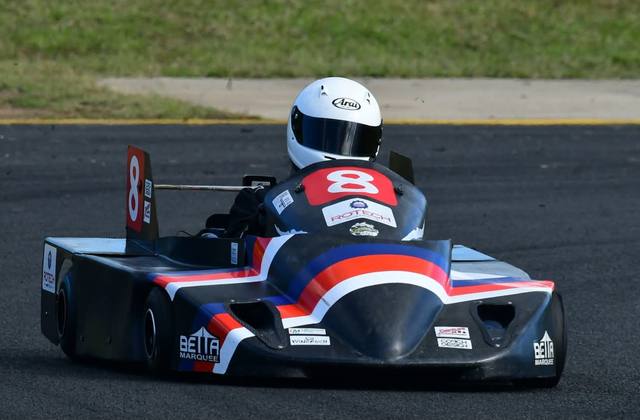
The premier class of superkarting, in Australia and around the world, where it’s known as Division 1. With a combined kart-and-driver weight of 225 kg and well over 100 hp, the power-to-weight ratio is enough to make you weak at the knees.
They reach 250 km/h, and at some tracks hold faster lap records than V8 Supercars. Purpose-built 250cc in-line twin-cylinder engines drive six-speed sequential gearboxes, with full aerodynamic bodywork and four-wheel disc brakes. They’re physically demanding, and not for the faint-hearted.
You’ll spot a 250 International by its yellow number plates with black numbers. A competitive package costs around $15,000. It’s true club-level motorsport that laps the country’s circuits faster than your neighbour’s Ferrari, and it all packs into a box trailer.
Not sure which class is for you?
Tell us your budget and how much spanner time you're up for, and we'll point you in the right direction.